

Of all the numbers a baseball player can post, the 60-yard dash is the most universal. Every college coach knows what a 6.9 means, and it appears on every showcase profile ever written.
It is also one of the most trainable numbers in the sport — and the one most young players have never actually been coached on.

What the Numbers Mean
| 60-yard time | Level | Notes |
|---|---|---|
| Under 6.6 | Elite | Top-end Division I speed; a genuine weapon |
| 6.6 – 6.9 | Strong D1 range | Draws attention on any profile |
| 7.0 – 7.2 | Solid college prospect | D2, NAIA and JUCO range |
| 7.3 – 7.6 | Good high school | Competitive varsity speed |
| 7.7 – 8.2 | Developing | Typical 13U-15U range |
| 8.3+ | Needs work | Large gains usually available here |
One caveat worth knowing: timing methods differ. Hand-timed numbers run roughly two tenths faster than laser-timed ones, so a hand-timed 6.8 and a laser 7.0 may be the same run. When a number is quoted, ask how it was taken.
Why Speed Matters Beyond the Number
The 60 is used as a proxy because it correlates with things coaches actually care about — defensive range, baserunning value, and general athleticism.
It also opens positions. Speed is what makes a centre fielder rather than a corner outfielder, and it is part of what separates a shortstop from a third baseman — as our guide to baseball positions explains. That positional flexibility matters a great deal in college recruiting.

The Start Is Half the Race
Over 60 yards, most players never reach true top speed. The race is decided in the first 20 yards — which is excellent news, because that is the most coachable part.
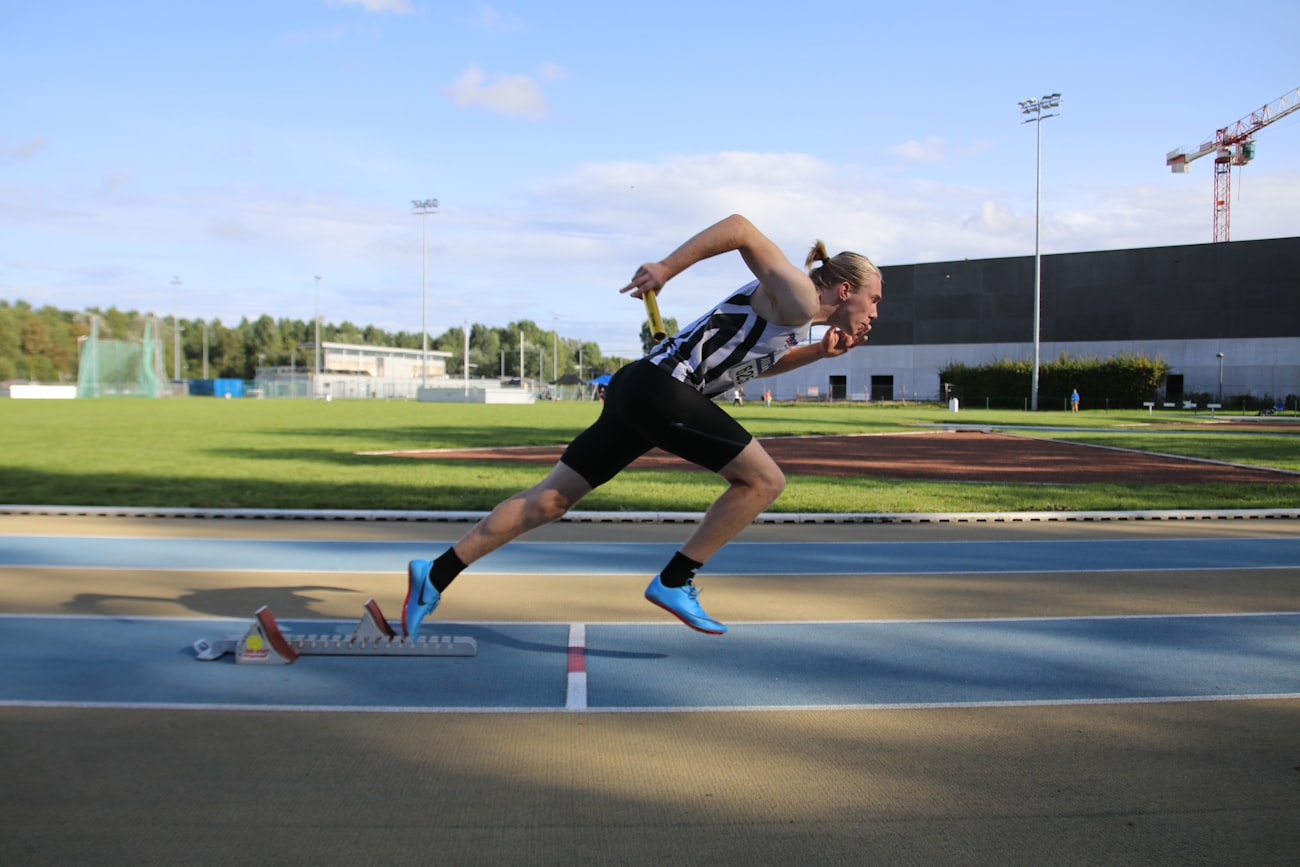
- Stagger the stance. Feet apart, weight forward over the front foot, knees soft. Balanced but ready to fall forward.
- Lean, do not stand up. The first steps should have a steep forward body angle and a positive shin angle.
- Push, do not reach. Drive the ground backward rather than stretching the front foot out.
- Arms drive hard — elbows roughly 90 degrees, hand from cheek to hip.
- Rise gradually over 15-20 yards rather than popping upright at step three.
Most young players make the same error: they stand up immediately. It feels fast and it is not. Correcting the first three steps alone commonly finds a tenth or two.
Nearly every young player we time is leaking two or three tenths in the first fifteen yards. That is free speed, and it costs nothing but coaching.
WAR Baseball coaching staff

The Second Half
Once upright, the priority changes from acceleration to holding form while fatiguing.
| Element | What to do | Common error |
|---|---|---|
| Posture | Tall, stacked, relaxed shoulders | Leaning back or tensing up |
| Knee drive | Front knee up and through | Short, shuffling steps |
| Ground contact | Strike under the hips | Reaching the foot out front |
| Arms | Long, relaxed drive | Tight, chopping motion |
| Face and jaw | Relaxed | Straining — it slows you down |
Relaxation genuinely matters. Tension slows sprinting, and players who strain over the final 20 yards decelerate more than those who stay smooth.

Training That Produces Speed
| Training | Effect on the 60 | Where it fits |
|---|---|---|
| Sprint mechanics coaching | High — often the fastest gain | Year-round, low fatigue |
| Acceleration work (10-20 yd) | High | 2x per week, fully rested |
| Lower-body strength | High over months | Off-season priority |
| Plyometrics and jumps | Moderate to high | After a strength base is built |
| Sled pushes and hill sprints | Moderate — builds drive phase | Off-season and pre-season |
| Hip and ankle mobility | Moderate — unlocks range | Daily, cheap to do |
| Long-distance running | Negative | Not useful for baseball speed |
That last row surprises people. Distance running does not make baseball players faster and can work against the explosive qualities the sport needs. Baseball is a series of maximal short efforts, and training should reflect that.
Guidance from USA Track & Field, the national governing body for the sport that studies sprinting most closely, is a useful reference for anyone building a genuine speed programme.
Sprint work sits naturally in the power phase of an off-season — our off-season training guide lays out how the phases fit together.

A Simple Weekly Structure
| Day | Focus | Volume |
|---|---|---|
| Monday | Acceleration — 10 to 20 yard starts | 6-8 reps, full recovery |
| Tuesday | Lower-body strength | Squat, hinge, single-leg work |
| Thursday | Top-speed and form runs | 4-6 runs at 40-60 yards |
| Friday | Strength and plyometrics | Jumps, bounds, medicine ball |
| Weekly | Mobility | 10 minutes daily, hips and ankles |
Two rules govern all of it. Sprint work must be done fresh — speed training when fatigued builds endurance, not speed. And quality beats volume every time; six good sprints beat twenty tired ones.
Note what is absent: there is no sprint work the day after a heavy lower-body session, and no speed day stacked onto a tournament weekend. Speed is a quality trained in a recovered state.
Where to Start
Get timed properly first, so there is a real baseline rather than a guess. Then spend four weeks on mechanics alone before adding volume.
Speed and agility training is built into team membership at Powermill for our players, twice a week alongside practice. If your player wants to be evaluated and given a genuine starting point, our coaches do exactly that at tryouts.
If a showcase is on the horizon, arrive rested — a tired 60 is a wasted one, as our showcases guide explains, and recovery matters more than most players think, as our sleep and recovery guide sets out.
Frequently Asked Questions
What is a good 60-yard dash time for baseball?
Under 7.0 seconds draws college attention, and under 6.8 is genuinely fast. Around 7.2-7.5 is solid for a high school player, while most middle-school-aged players fall between 7.8 and 8.5. Times vary with timing method, so ask how a number was recorded.
How can a baseball player get faster?
Sprint mechanics coaching, lower-body strength and acceleration work produce the largest gains. Most young players have never been taught how to start or how to hold form, so technique alone often removes two to three tenths of a second.
Does lifting weights make you faster?
Yes, when it targets the right qualities. Speed is force applied into the ground, so squats, hinges and jump training build the base. Strength without sprint technique produces less improvement than the two combined.
How long does it take to improve a 60-yard dash time?
Technique changes can show within a few weeks. Meaningful physical gains take a full off-season — roughly eight to twelve weeks of consistent work. Speed responds well to training but not overnight.
Where is the 60-yard dash timed from in baseball?
It is run from a standing start, usually along a straight line beside the outfield or from first base toward third. There are no blocks. The start is a large part of the time, which is why stance and first steps are worth practising.
Get Timed and Get Faster
Speed and agility work is part of team membership at WAR Baseball. See upcoming tryouts for 13U through 17U in Tallahassee.